


We start this Deep Dive series in Chile 🇨🇱
Follow along the 8-part series here.
Welcome to Going Places Deep Dive!
In this new series, we'll feature places from around the world we've personally traveled to, discovered through the voices of people who live and work there.
Each week, we'll share context to help you understand these places a little better, then introduce you to a region, a phenomenon, or a person to know, should you go there yourself.
Upcoming profiles include places like Greece, Kazakhstan, and Jordan.
Today, we start with an 8-part deep dive on Chile.
Chile is the longest and narrowest country in the world (although that first claim is contested with Brazil).
It's also the world's southernmost, lying just 400 miles north of Antarctica.
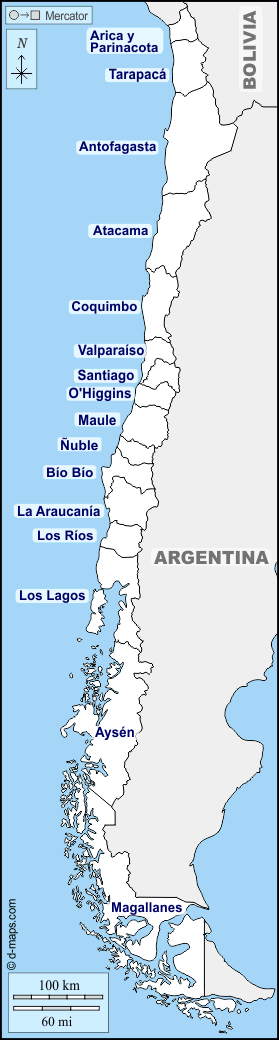
Sandwiched between the Pacific Ocean and the Andes Mountains on the western side of South America, the country stretches over 2,600 miles in the shape of a boomerang.
That same distance could take us from Northern Morocco to Arctic Norway or from Mexico City to Manitoba in Canada. 😱
Perhaps two of the country's most famous regions are the high-altitude desert of Atacama in the north and the glacial Patagonia in the south.
But Chile is so diverse that its 16 regions represent an incredible array of landscapes, cultures, and flavors: from the pastoral coast of Chiloé Island and the fertile valleys of Coquimbo to the rainforests of La Araucanía and the grasslands of Arica.
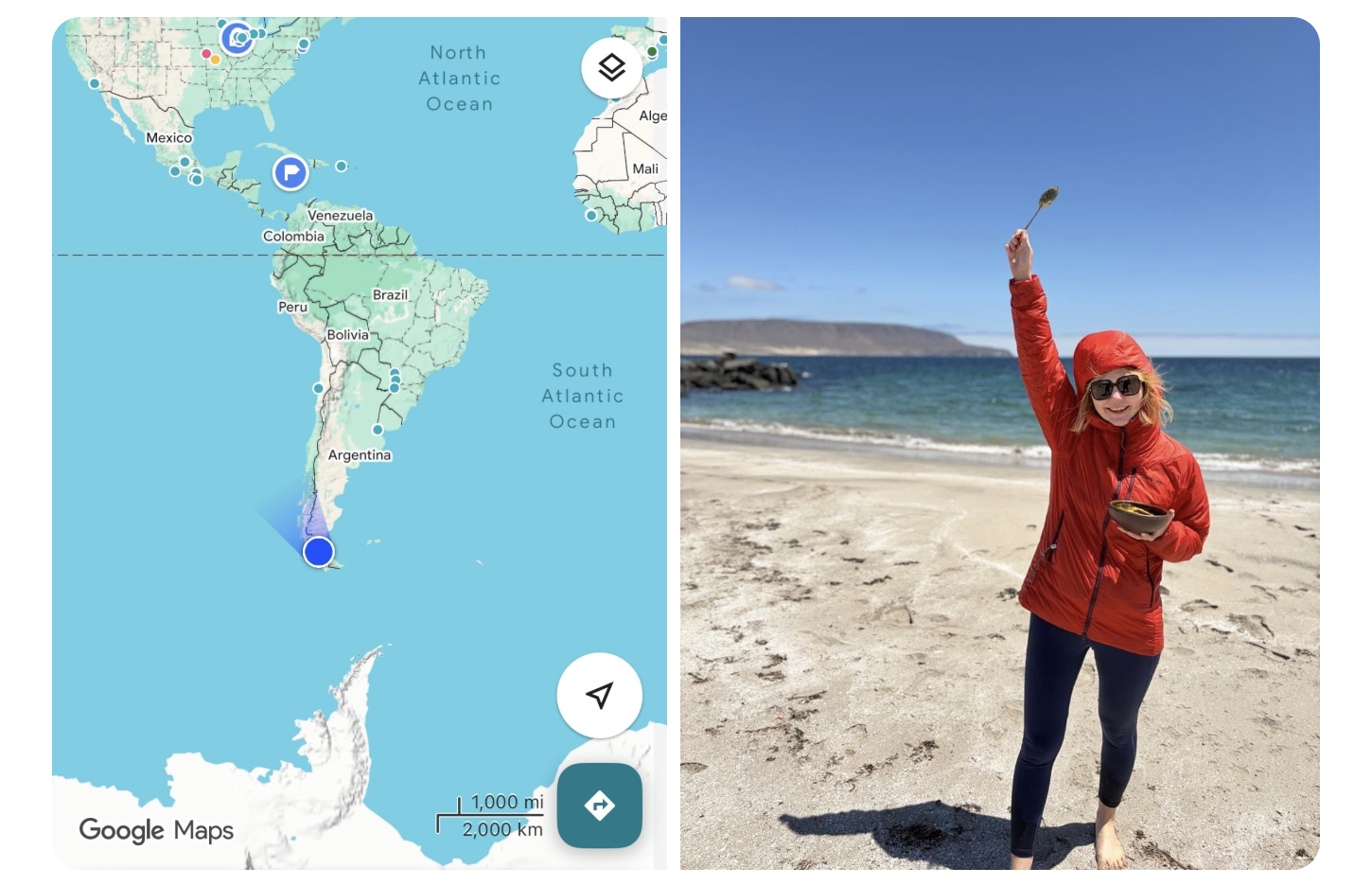
I traveled to Chile four times over the course of a few months late last year and early this year.
I first arrived for the ATTA Summit held in Puerto Natales, Patagonia, then fell in love with a man there and returned again and again – but that's a story for another time.
This series will focus on Atacama and Patagonia because that's where I've personally traveled. These are popular regions, but in this deep dive, you'll get to know them mostly through the Indigenous lens, a rarely seen perspective.
Its painful periods include Spanish colonial conquest and the extermination of the Indigenous peoples by both the Spanish and later Chilean military forces.
In the 1970s, the U.S. destabilized the democratically elected socialist government of Salvador Allende, "making the economy scream," in the words of then-President Richard Nixon, and leading to the eventual military coup and brutal 17-year regime of General Augusto Pinochet.
Earlier this year, Chile inaugurated the most far-right president since Pinochet, José Antonio Kast, whose father belonged to the Nazi Party in Germany.
At present, Chile officially recognizes 11 Indigenous groups, of which the Mapuche and the Aymara are the largest.
But many of these groups are fighting for land, water, and their rights to this day.
Chile holds the largest reserves of copper and lithium in the world, and its lithium mines are sucking the rivers dry in Atacama.
All across the desert, the Indigenous communities are facing Chilean and foreign mining companies whose activities disrupt fragile ecosystems, deplete crucial water sources, and threaten their very existence.
In this NRDC story, Indigenous activist Elena Rivera Cardoso says: "...in all of Chile, there are rivers and lakes that have disappeared—all because a company has a lot more right to water than we do as human beings or citizens of Chile."
The global explosion of AI is intensifying this mining boom, with real costs being paid by people far away from our laptops.
This extends beyond Atacama.
In the southern La Araucanía region, for example, Mapuche groups have led a decades-long struggle for land rights to prevent industrial logging that replaces native forests with monoculture and drains local water supplies.
Today, many human rights activists and Indigenous groups are concerned about what's to come under President Kast.
"A company has a lot more right to water than we do as human beings or citizens of Chile."
I had known none of this when I first arrived in Chile, because most travel conversations rarely go this deep.
After visiting Chile and learning about some of these struggles first-hand, I wrote about how your travel choices can help for AFAR Magazine.
But one 800-word article can only do so much.
I started Going Places as a platform where Indigenous voices and wisdom are centered and celebrated partly for this reason.
Here, we have the space and the time to go as deep as we need to cover topics that help us all move through the world with more empathy, solidarity, and awareness.
That's why, throughout this series, you'll hear various voices and perspectives that reflect the Indigenous experience in Chile today. I hope you enjoy it!
See you with Part 2 next Wednesday,
Yulia
To arrive in Puerto Natales, book a flight to Santiago on any international carrier, then try LATAM or SKY for Puerto Natales Airport. A six-hour flight from Santiago to PNT takes you to this base town for Patagonia.
In Puerto Natales, I stayed at the Remota Lodge – a design hotel with stunning views of the fjords and an impressive kitchen.
My trip to Atacama was fulfilled by Alaya, a local tour operator that serves as the connective tissue between the area's many Indigenous groups and experiences. I visited the lesser-known part of the desert where most foreign travelers never reach. To get there, I flew from Santiago to Copiapó on LATAM.
Like our work?
1. Spread the word about our Chile series by using that Share button below. We are not on Substack by choice (more on this later), but it also means that it's harder for our stories to reach a wider audience. Your support is crucial!
2. Become our paid member to help us create more coverage like this


Member discussion