


We start this Deep Dive series in Chile 🇨🇱
Follow along the 8-part series here.
Our Chile Deep Dive series continues today from the southern part of the Atacama Desert: the fertile Huasco Valley.
(Catch up on Part 3 here.)
Many working in tourism here are hopeful it can help reduce the region’s reliance on large-scale mining projects.
But mining – the artisanal way – is also part of southern Atacama's story.
Long before the Inca and the Spanish arrived, the region's Indigenous Molle, Animas, and Diaguita cultures already used sophisticated metallurgy techniques.
The Diaguita, for example, built wind-driven furnaces known as huayras. Pierced with small holes, these clay ovens captured the power of mountain winds to reach smelting temperatures without the use of bellows.
In nearby Copiapó, metallurgical remains are still visible at Viña del Cerro, one of the area's most famous pre-Inca copper smelting sites.
Called "the mother of all Andean metals," copper was an important element in all aspects of everyday Indigenous life, but this ancient metallurgical tradition is not as well understood as its counterparts in Europe and elsewhere.
Today, one man in the Huasco Valley is bringing its legacy to the forefront through his craft.
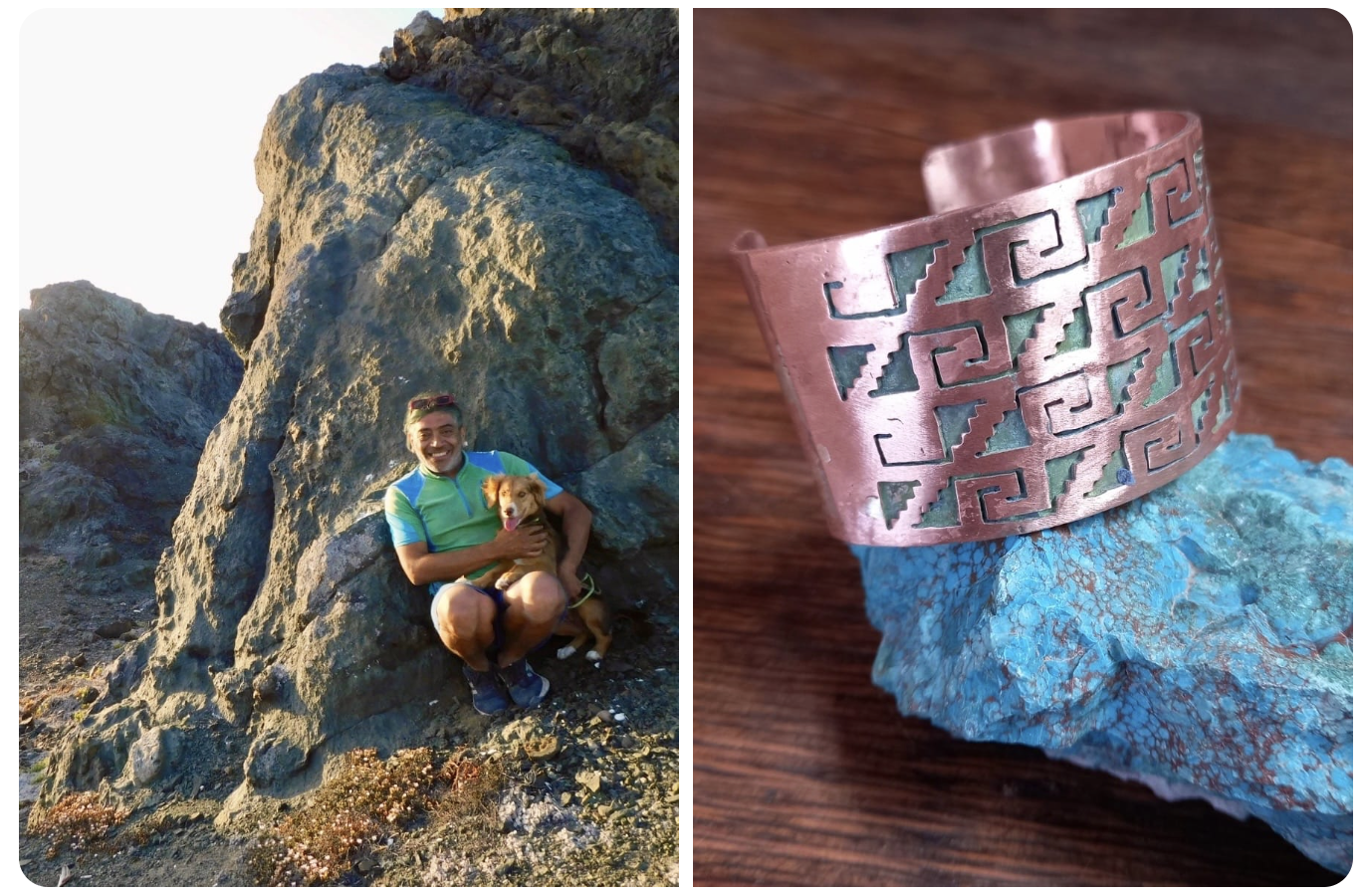
Meet Iván Torres, a Diaguita jewelry maker.
Iván is an Indigenous artisan in Vallenar, the largest town of the Huasco Valley.
Placing ancestral Diaguita designs into wearable objects, he tells the story of Atacama's artisanal mining anew.
Here is Iván talking about his work.
Together with Iván, Stefi runs tours in the Huasco Valley. During my trip, Stefi and I witnessed the blooming desert at the 📍Llanos de Challe National Park side by side.
Learn more about Stefi and Iván's tours on Instagram at @indianvalleyexplorers.
(This interview has been lightly edited for clarity.)
"I used to work as an aquaculture technician,
but I had to stop practicing it for health reasons and, instead, decided to dedicate myself to the craft of copper.
Initially, I aspired to work with gold, but that changed once I realized that in the Huasco Province, there were so many archaeological copper finds.
[Editor’s note: items unearthed in southern Atacama include axes, tweezers, pins, and ornaments used in clothing.]
I discovered that ancient Indigenous peoples of this territory already knew how to work with this metal. Theirs was a culture that mastered copper casting, rolling, and jewelry making.
Although this legacy exists, the technique didn't survive to the present day.
To revitalize this culture, I decided to work in this craft, making modern jewelry with silver, copper, and other minerals from the area.
History books often say that the Incas, who arrived in Atacama in the 15th century, started metallurgy in this area.
But seeing the remains of small-scale mining in the Atacama Region shows that here, working with copper stretches further back.
For example, the El Molle culture, which inhabited this land since about 200 BC, was among the first societies to introduce metallurgy to the Andes.
The Molle traditions were passed down to their succeeding cultures: the Animas and later, the Diaguitas. My ancestors were famous for their crafts like textiles and geometric pottery, but their mastery of metallurgy hasn't received much attention.
I have been working all this time to gain recognition as a Diaguita copper metalsmith. Much like the Mapuche have their silver, the Diaguita could have their own copper artisans. However, that has yet to come.
Theirs was a culture that mastered copper casting, rolling, and jewelry making.
Today, one can find many books that teach various techniques of working with gold and silver, but there aren't any that teach you how to turn copper into jewelry.
Special thanks to our 60+ paid members who make Going Places possible.
That’s why I started looking for the iconography that the Diaguitas applied to their sophisticated pottery. I used these pottery symbols as fretwork (latticed) designs, transferring them to metal.
So that’s the path I followed: using jewelry techniques on copper and other metals, working with the designs my ancestors left on pottery, and drawing inspiration from other symbols that connect us to this land, such as guanacos or cacti.
I‘m drawn to working with fire – applying it to metals, watching it melt and shape them. You can create so many things; for instance, you can combine silver, which I work with in its pure form, with copper into a single piece. I find it fascinating.
In a way, artisanal mining of local minerals also connects me to this land and its ancient inhabitants. I want to continue highlighting copper, which is often considered the "poor brother" of precious metals.
By revealing the entire process – from mineral extraction to melting and crafting copper tools and jewelry – my goal is to revitalize jewelsmithing that was once lost to history and that today is becoming linked to Diaguita culture again.
➡️ In Vallenar, you can visit Iván in his workshop or see his work at the Pukará Cultural Center.
Going Places is a platform where Indigenous voices and wisdom across the world are centered and celebrated. Here, we have the space and the time to go as deep as we need to cover topics that help us all move through the world with more empathy, solidarity, and awareness.
That's why, throughout this series, you'll hear various voices and perspectives that reflect the Indigenous experience in Chile today.
Like our work?
1. Spread the word about our Chile series by using that Share button below. We are not on Substack by choice (more on this later), but it also means that it's harder for our stories to reach a wider audience. Your support is crucial!
2. Become our paid member to help us create more coverage like this
100% human-made | Become a member to support our work here
RISE Travel Institute is our Founding Member
RISE is a nonprofit with a mission to create a more just and equitable world through travel education.
➡️ This November, RISE is running the Experiential Journey to the Indian Himalayas. Their RISE Traveler Pathway is a new self-paced program for travelers, digital nomads, content creators, and tourism practitioners centered on justice and systems thinking. Use code GoingPlacesCommunity for 10% off!
Interested in your organization becoming a Founding Member? Get in touch here.
Radostina Boseva is our Founding Member
Radostina Boseva is a film wedding photographer with an editorial flair based between SF and Europe.
To get a shout-out like this in every issue, join us as an individual Founding Member here.
We pay $1,008 a year to host Going Places online. Help us offset this cost with a one-time tip 🙏


Member discussion